Hongshan Culture
Overview
The Hongshan Culture, dating back approximately 5,000 to 6,500 years, is one of the earliest known cultures in China and plays a significant role in understanding the origins of Chinese civilization. It is recognized as a Neolithic culture that existed in the West Liaohe River basin, spanning regions that today are part of the Inner Mongolia autonomous region and Liaoning province. This culture is renowned for its exquisite jade artifacts and the development of early ritualistic traditions.
Archaeological Discoveries
Significant archaeological findings from the Hongshan Culture include large-scale ceremonial sites such as the Niuheliang site, discovered in the 1980s in Chaoyang city, Liaoning province. Excavations at Niuheliang revealed an altar, a temple, rubble mound tombs, jade ritual ware and painted potteries, which offer a glimpse into the societal and ritualistic practices of the Hongshan people. The site's layout and the nature of the artifacts suggest a sophisticated society with a complex belief system centered around sacrificial rites and ancestor worship.
Cultural Significance
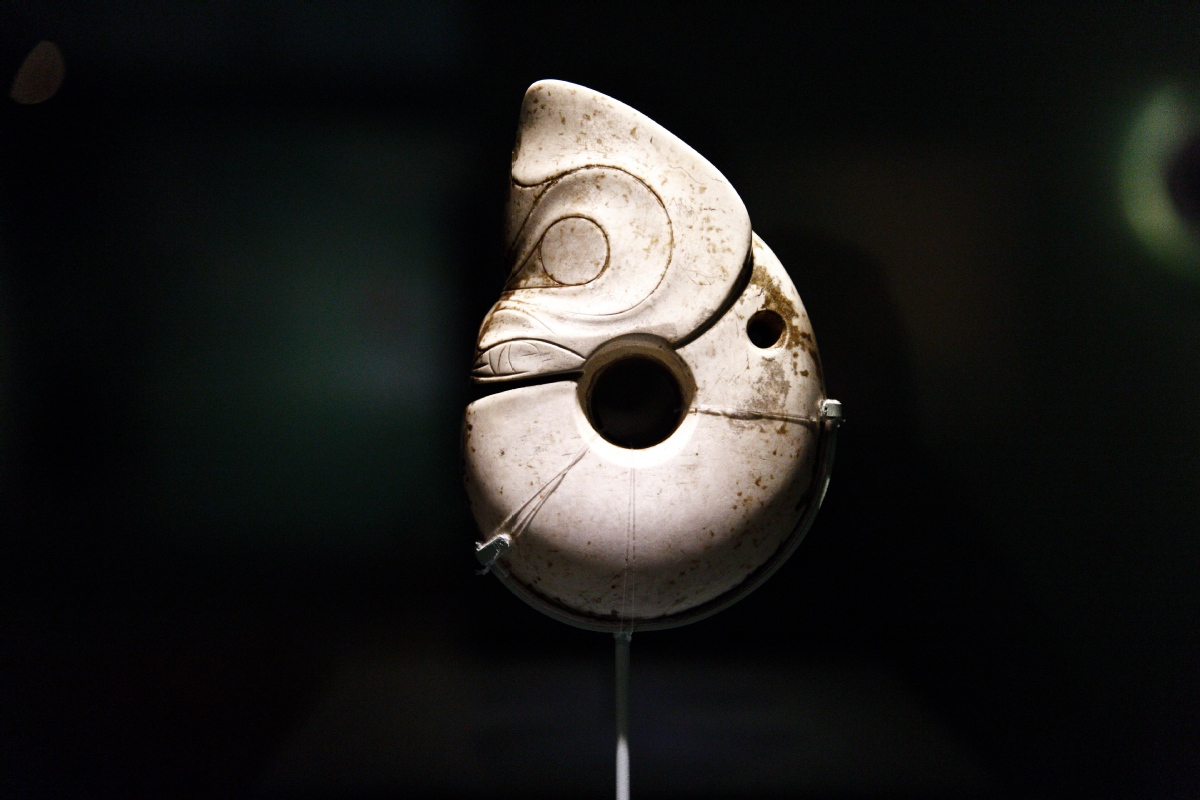
The Hongshan Culture is often referred to as the "tap root" of ancient Chinese culture, influencing subsequent cultures and civilizations. The jade artifacts, decorated with motifs of dragons, phoenixes and turtles, reflect the institutionalization of religious practices and beliefs. These motifs are believed to be early representations of the dragon, a symbol that has become deeply ingrained in Chinese cultural heritage. The culture also illustrates early social stratification, as evidenced by the varying statuses of the tombs and the types of grave goods found within.
Hongshan Culture is compared with other Neolithic cultures such as the Yangshao Culture in the Central China Plains and the Liangzhu Culture in the Yangtze River Basin. The Hongshan Culture is notable for its integration of influences from neighboring cultures, demonstrating a degree of cultural exchange and interaction.
The legacy of the Hongshan Culture is evident in its continuing influence on Chinese ritual practices and artistic traditions. The culture's emphasis on ritualistic jade artifacts underscores the importance of jade in Chinese culture, which persists to this day. Moreover, the Hongshan Culture's contributions to the development of early Chinese civilization are recognized as foundational, providing insights into the formation of complex societies and the evolution of cultural practices over millennia.
Contributions of International Archaeologists
The study of the Hongshan Culture has benefited significantly from international archaeological collaboration. Johan Gunnar Andersson, a Swedish archaeologist, made early connections between sites in the region and the Yangshao Culture in the Central China Plains. Although he did not specifically identify Hongshan Culture, his work laid the groundwork for future discoveries. Japanese archaeologist Shingo Akiyama led a Sino-Japanese cooperative research team that completed the mapping of No 16 site of Niuheliang, contributing detailed geographic data to the study. Moreover, Christian E Peterson from the United States introduced systematic regional-scale survey methods and household analysis, which enhanced the depth and breadth of the archaeological investigations.
Recent Research and Discoveries
Ongoing archaeological research at sites associated with the Hongshan Culture continues to uncover new information about this ancient society. Discoveries such as the C-shaped jade dragon and other unique jade artifacts have further illuminated the spiritual and cultural life of the Hongshan people. These findings contribute to a deeper understanding of the complexity and sophistication of early Chinese civilizations and their enduring impact on the region's cultural heritage. Article reference1. Prehistoric jade objects trace a civilization's origin. chinadaily.com.cn. 20202. Unified origins in roots of Chinese civilization. chinadaily.com.cn. 20233. Niuheliang National Archaeological Site Park. chinaservicesinfo.com. 2021Photo Gallery(10 pictures)CategoriesCultural HeritageTagArchaeological DiscoveryRelatedSite of NiuheliangSongze SiteNiuheliang National Archaeological Site ParkCatalogue1. Overview2. Archaeological Discoveries3. Cultural Significance4. Contributions of International Archaeologists5. Recent Research and Discoveries- - - []








